

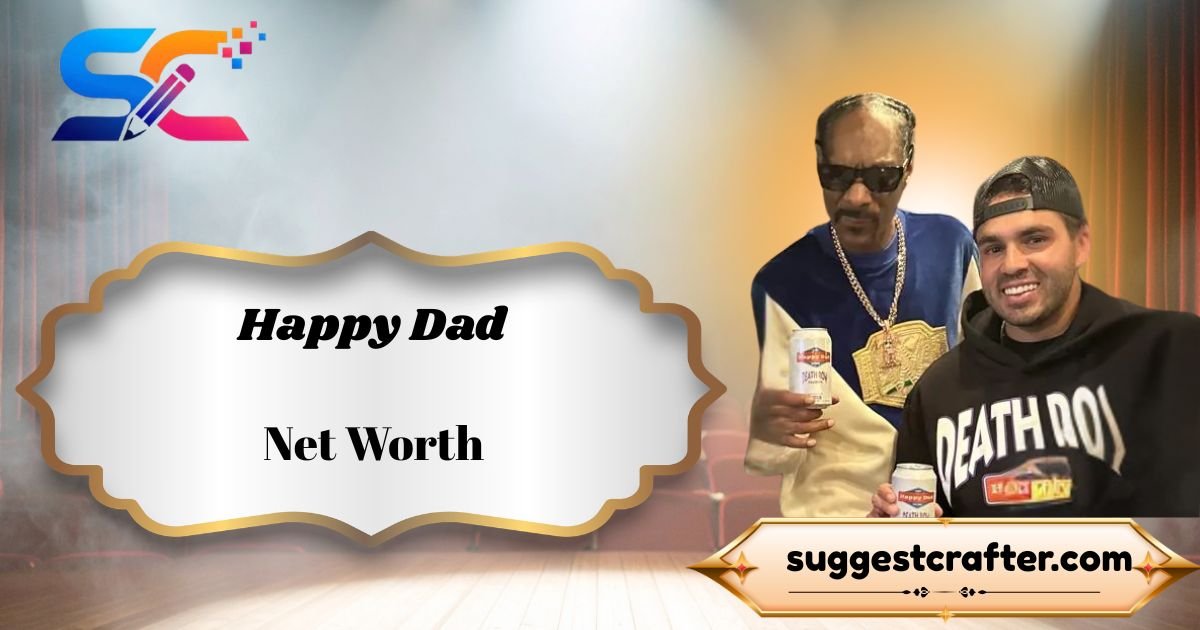
Happy Dad has grown from a YouTube side project into one of the fastest-rising names in the U.S. hard seltzer market. Launched in 2021 by the Nelk Boys and the Shahidi brothers, the brand now competes directly with White Claw and Truly on retail shelves nationwide.
Public curiosity about Happy Dad net worth has grown alongside its sales numbers, and for good reason: few beverage startups reach a nine-figure valuation in under five years. In this article, you’ll learn who owns Happy Dad, how the company built its brand, what its 2026 net worth is estimated to be, and how it stacks up against competitors in revenue, distribution, and market share.
Quick Facts: Happy Dad Hard Seltzer
| Category | Details |
| Brand Name | Happy Dad Hard Seltzer |
| Founded | 2021 |
| Founders | Kyle Forgeard, Sam Shahidi, John Shahidi |
| Headquarters | Orange County, California |
| Industry | Alcoholic Beverages (Flavored Malt Beverage) |
| Employees | 200+ |
| Estimated Annual Revenue | $67M–$100M |
| Estimated Net Worth (2026) | $250M–$300M |
| Market Rank (Convenience Stores) | 3rd–4th in U.S. hard seltzer category |
Who Owns a Happy Dad?
Happy Dad is majority-owned by Kyle Forgeard, Sam Shahidi, and John Shahidi. Forgeard is the co-founder of NELK, the YouTube channel known for prank and lifestyle content that built the Full Send audience. According to reports, his personal net worth sits around $25 million, separate from his stake in Happy Dad itself.
Sam and John Shahidi bring a different skill set to the table. Both come from Shots Studios, a digital media company Forbes once compared to the Air Jordan of the internet world. John Shahidi serves as President of Happy Dad, while Sam Shahidi holds the CEO title and steers day-to-day strategy.
Other Nelk-adjacent personalities, including SteveWillDoIt, are closely associated with the brand through promotion and content, though public filings don’t confirm direct equity ownership for every name linked to the Full Send ecosystem. The core control of the company remains with its three founding partners.
How Happy Dad Became So Popular
Happy Dad didn’t launch with a traditional ad campaign. Instead, it leaned on an existing audience of millions of Nelk Boys subscribers who already trusted the founders’ recommendations. That built-in fanbase gave the brand instant credibility in a category usually dominated by decades-old beer companies.
The product itself also broke convention. While most hard seltzers ship in 12-ounce cans, Happy Dad chose 16-ounce cans from day one. This gave customers more product per can, which made the brand stand out physically on crowded convenience store shelves, even before a single advertisement ran.
Word-of-mouth marketing, paired with constant appearances on the Nelk YouTube channel and Full Send Podcast, kept the brand in front of a young, engaged, alcohol-buying demographic. That combination of built-in audience and product differentiation is a major reason Happy Dad’s popularity scaled so quickly between 2021 and 2026.
Happy Dad’s Rise to Success
The brand’s early growth numbers back up the hype. By 2024, Happy Dad’s case volume had jumped 44% year-over-year to roughly 3.5 million cases, one of the strongest growth rates of any flavored malt beverage brand that year. That kind of momentum is rare in a category where legacy brands typically post low single-digit growth.
By early 2026, Happy Dad had climbed to the number three spot in hard seltzer sales across Western U.S. convenience stores, ahead of established names like Topo Chico Hard Seltzer and Vizzy. Nationally, it ranked fourth in the broader U.S. convenience store channel.
Initial Struggles and Successes
Happy Dad wasn’t an overnight guarantee. Early on, the founders faced skepticism from beverage distributors who doubted that a YouTube-driven brand could compete with legacy players backed by Anheuser-Busch and Molson Coors.
Securing shelf space in a category already crowded with White Claw, Truly, and High Noon required persistence and direct relationships built through the founders’ existing network.
By 2023, those struggles had largely turned into wins. Happy Dad secured national distribution deals and used podcast integrations, including a partnership tied to the Joe Rogan Experience audience, to keep expanding brand recognition well beyond the original Nelk fanbase.
Happy Dad Net Worth (2026)
Heading into 2026, Happy Dad net worth is estimated between $250 million and $300 million. This figure isn’t an official public filing since the company remains privately held, but it reflects consistent estimates from multiple industry analysts and beverage sector benchmarks.
That valuation accounts for more than just can sales. It includes brand equity, merchandise revenue, sponsorship deals, and the value of Happy Dad’s distribution network across major U.S. retailers. Public estimates suggest annual revenue in the range of $67 million to $100 million, a wide band that reflects the difficulty of tracking privately held beverage company financials with precision.
Compared to where the brand started in 2021, this growth trajectory is exceptional. Most alcohol brands take a decade or longer to reach a fraction of Happy Dad’s current valuation, which underscores how much of an advantage a pre-built audience provides in the modern beverage industry.
Inside the Business Model
Happy Dad’s core product strategy centers on value and differentiation. The 16-ounce can format gives customers more volume than the industry-standard 12-ounce format, all while staying competitively priced against major hard seltzer brands.
Revenue doesn’t come from beverage sales alone. Happy Dad has built a diversified income model that includes branded merchandise, cross-promotions with Full Send apparel, and sponsorship integrations across Nelk’s YouTube and podcast content. This buffer means the company isn’t entirely dependent on can sales to sustain growth.
Retail expansion has been just as important as product design. Distribution agreements with major grocery chains and convenience store networks allowed Happy Dad to scale nationally faster than most influencer-founded beverage brands, which often stay limited to direct-to-consumer or regional sales for years.
Happy Dad’s Marketing and Brand Lifestyle
Happy Dad sells more than a drink; it sells an identity. The branding leans into humor, community, and an approachable “we’re just like you” tone that resonates with a younger, largely male demographic already familiar with the Full Send brand.
Instead of polished, traditional beer commercials, Happy Dad’s marketing feels like an extension of the founders’ YouTube content: casual, unscripted, and built around real moments rather than staged advertising. This authenticity has become one of the brand’s biggest differentiators in a category where most competitors rely on big-budget national ad campaigns.
Additionally, the brand ties its identity to specific cultural moments, tailgates, road trips, and everyday hangouts, positioning Happy Dad as a lifestyle product rather than just another can on the shelf. That lifestyle branding has helped the company build loyalty that’s harder for legacy brands to replicate.
Social Media and Viral Success
Social Media Strategy
Happy Dad’s social presence functions as an extension of the Nelk content machine rather than a separate corporate account. Product placements happen naturally inside existing videos, podcasts, and livestreams, which keeps promotional content from feeling like traditional advertising.
This strategy also lowers customer acquisition costs significantly compared to beverage companies that rely on paid media. Because the audience already trusts the founders, product mentions convert into sales at a rate traditional ad spend struggles to match.
Viral Campaigns
Several moments have driven outsized attention for the brand, including pop-up events, giveaways tied to Nelk content drops, and appearances at major sporting and entertainment events. These campaigns generate earned media coverage without requiring the large marketing budgets legacy beverage companies typically spend.
The brand has also benefited from podcast integrations that reach audiences well beyond its original fanbase, helping Happy Dad cross over into mainstream beverage conversations rather than staying confined to influencer culture.
Revenue and Brand Value
Estimates place Happy Dad’s annual revenue between $67 million and $100 million as of 2026, with the company employing more than 200 people across production, sales, and marketing functions. Revenue per employee is estimated around $297,000, a figure that reflects the brand’s lean operational structure relative to its sales output.
Brand value estimates, separate from pure revenue figures, land in the $250 million to $300 million range. This gap between revenue and valuation is typical in the beverage industry, where multiples reflect growth potential, cultural relevance, and distribution reach rather than current-year sales alone.
Analysts point to continued upward movement in 2026, driven largely by expanding retail placement and international interest, rather than any single blockbuster product launch.
Comparisons to Competitors
White Claw remains the dominant player in the hard seltzer category by a wide margin, and Truly holds a strong second-place position
However, growth rates tell a different story than market share alone. While White Claw posted roughly 4.5% year-over-year growth and Truly actually declined by 8.6% over a recent measurement period, Happy Dad posted growth of approximately 11.48%, one of the highest rates in the entire category.
Key Insights from the Comparison
This growth disparity matters because it shows Happy Dad isn’t just holding steady in a mature category; it’s actively taking share from larger, more established brands. Category leaders with massive marketing budgets are seeing flat or declining performance, while Happy Dad continues to climb rankings in specific regional markets like the Western United States.
That said, scale still favors the incumbents. White Claw and Truly both benefit from decades of brand recognition and far larger production capacity, meaning Happy Dad’s percentage growth, while impressive, is happening from a smaller revenue base.
Where Is Happy Dad Sold?
Happy Dad is available across all 50 U.S. states and parts of Canada, a significant expansion from its regional 2021 launch. Major retail partners include Walmart, Kroger, and Albertsons, giving the brand access to some of the largest grocery footprints in the country.
Costco also carries Happy Dad on the warehouse club side, which typically requires brands to meet strict volume and quality benchmarks before earning shelf space. Beyond grocery, the brand maintains a strong presence in convenience stores, where it currently ranks third to fourth nationally depending on the specific market and measurement period.
International expansion is also underway, with reports indicating plans to bring Happy Dad into European and Australian markets as part of a broader global growth strategy heading further into the decade.
Happy Dad’s Founders and Vision
Kyle Forgeard’s vision for Happy Dad grew directly out of his experience building the Nelk brand. After studying filmmaking at Ryerson University and later leaving to focus on YouTube, Forgeard co-founded Nelk, which became known for prank and challenge content before evolving into the broader Full Send media company.
Sam and John Shahidi added the operational and business development expertise needed to scale a beverage company nationally. Their background running Shots Studios gave them experience managing talent-driven brands, a skill set that translated directly into building Happy Dad’s retail and marketing infrastructure.
Together, the founders’ vision was straightforward: use an existing, loyal audience to launch a product category they already consumed and talked about constantly. That direct alignment between founder audience and product category is a major reason the brand scaled faster than typical beverage startups.
What Does Happy Dad Taste Like?
Happy Dad is known for a smooth, crisp, and refreshing taste with low carbonation compared to many competing hard seltzers. Each can is made with natural flavors and contains just one gram of sugar and roughly 100 calories, positioning it as a lighter option within the flavored malt beverage category.
The brand markets itself as gluten-free and includes electrolytes in its formulation, features aimed at health-conscious drinkers who still want a flavorful option. This combination of low sugar, moderate calories, and clean finish has helped Happy Dad compete directly against category leaders that emphasize similar health-forward attributes.
Flavor variety plays a role too, giving customers enough options to avoid the “one taste fits all” feeling of some canned seltzer brands.
What Alcohol Is in Happy Dad?
Happy Dad is classified as a flavored malt beverage, meaning its alcohol base comes from fermented malted grain rather than distilled spirits or wine. Most varieties carry an alcohol by volume similar to standard hard seltzers, generally in the 5% ABV range, consistent with category norms set by brands like White Claw and Truly.
This malt-based formulation allows Happy Dad to be sold through the same distribution channels as beer, which significantly widened its retail access compared to spirits-based canned cocktails that often face more restrictive state-by-state regulations.
Tea, Flavors, and Fruit Punch
Beyond its original seltzer lineup, Happy Dad has expanded into additional product lines, including hard tea and fruit punch flavored options. This diversification mirrors a broader industry trend, as flavored malt beverage brands increasingly compete not just within hard seltzer but across adjacent categories like hard tea and canned cocktails.
Fruit punch and other bold flavor additions have helped the brand appeal to customers looking for something sweeter than a traditional seltzer, without stepping outside the low-calorie, better-for-you positioning that defines the brand. This flavor expansion strategy has been a meaningful contributor to Happy Dad’s overall case volume growth.
Happy Dad’s Growth and Future Plans
Looking ahead, Happy Dad’s leadership has signaled plans to continue expanding both domestically and internationally. Reports indicate the brand is working toward availability in European and Australian markets, aiming to establish a global footprint by the back half of the decade.
Domestically, further retail penetration remains a priority, particularly in convenience store channels where the brand has already shown it can outperform larger competitors on growth rate. Continued flavor innovation, including additional hard tea and fruit-based offerings, is also expected to play a role in sustaining momentum.
Given the brand’s current trajectory, industry analysts expect Happy Dad’s valuation to keep climbing through 2026 and beyond, assuming distribution growth and category demand remain steady.
Happy Dad’s Net Worth in Perspective
A $250 million to $300 million valuation is significant for any five-year-old company, but it’s especially notable within the alcohol industry, where brand trust typically takes decades to build.
Legacy beer and seltzer companies spend enormous marketing budgets trying to replicate the kind of organic loyalty Happy Dad built through its founders’ existing content platforms.
Compared to traditional beverage startups that rely entirely on distributor relationships and paid advertising, Happy Dad’s asset-light marketing approach helped it reach nine-figure brand value with a fraction of the typical launch costs. That efficiency is a key reason its net worth estimate continues to draw attention from beverage industry analysts.
Happy Dad Net Worth 2026
As of 2026, consistent estimates place Happy Dad’s net worth between $250 million and $300 million, with revenue estimated in the $67 million to $100 million range.
These figures come from industry analysts and beverage sector benchmarks rather than official public disclosures, since Happy Dad remains a privately held company.
Continued distribution growth, international expansion, and category outperformance all support the case for the brand’s valuation to keep rising through the remainder of the year.
Who is the CEO of Happy Dad?
Sam Shahidi serves as the CEO of Happy Dad Hard Seltzer. He co-founded the brand alongside his brother John Shahidi and Nelk’s Kyle Forgeard, bringing a background in digital media and business strategy from his time at Shots Studios.
Does Steve make money from Happy Dad?
SteveWillDoIt is closely associated with Happy Dad through content, promotions, and appearances tied to the broader Full Send ecosystem, and he benefits financially through these promotional and collaborative activities. However, his direct equity ownership in the company isn’t publicly confirmed in available filings.
Is Happy Dad a successful company?
Yes. Happy Dad is considered a highly successful beverage startup, with rapid case volume growth, national retail distribution, and a valuation estimated between $250 million and $300 million just five years after launch. Its year-over-year growth rate has outpaced several established category leaders.
Did Nelk sell Happy Dad?
No. Happy Dad remains under the control of its founding partners, Kyle Forgeard, Sam Shahidi, and John Shahidi. The company has not been fully sold to an outside buyer, though it’s worth noting that industry speculation about acquisition interest from larger beverage conglomerates has circulated as the brand’s valuation has grown.
Is Happy Dad a healthy drink?
Happy Dad markets itself as a lower-calorie, lower-sugar alternative within the alcoholic beverage category, with roughly 100 calories and one gram of sugar per can, plus added electrolytes. That said, it remains an alcoholic product and should be consumed responsibly regardless of its comparatively lighter nutritional profile.
What is a happy dad ranked in sales?
Happy Dad ranked fourth in U.S. convenience store hard seltzer sales as of late 2025, and climbed to third place across Western U.S. convenience stores by early 2026, surpassing brands like Topo Chico Hard Seltzer and Vizzy in that specific regional market.
Is Happy Dad healthier than beer?
Compared to many traditional beers, Happy Dad offers fewer calories and less sugar per can, which makes it a lighter option for drinkers watching their intake. However, “healthier” is relative within the alcohol category, and any comparison should account for serving size, ABV, and individual dietary needs rather than calorie count alone.
Happy Dad ownership percentage
Exact equity splits among Happy Dad’s founders haven’t been made public, which is typical for privately held companies. What is known is that Kyle Forgeard, Sam Shahidi, and John Shahidi hold the controlling ownership stakes, with Sam Shahidi operating as CEO and John Shahidi serving as President.
Conclusion
Happy Dad‘s rise from a Nelk Boys side project to a company valued between $250 million and $300 million shows how much a built-in audience and product differentiation can accelerate growth in a crowded market.
With national distribution, a diversified revenue model, and consistent year-over-year growth outpacing several legacy competitors, Happy Dad net worth estimates are likely to keep climbing through 2026.
Backed by founders Kyle Forgeard, Sam Shahidi, and John Shahidi, the brand’s combination of authentic marketing and smart product design has positioned it as one of the most closely watched success stories in the modern beverage industry.
